Advice Following an Adjustment
- Avoid rubbing, pushing or poking areas that your Chiropractor has adjusted.
- Avoid sudden jerky movements beyond the normal range of motion.
- Avoid excessive stretching and bending in any direction.
- If you need to lift anything, bend your knees and keep your back straight. This will help to decrease stress and strain on your lower back.
- Drink plenty of water.
- Go for a short walk.
Postural Advice
Sitting / Driving Posture
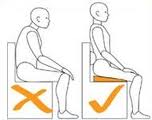
- Sit with a straight head and your chin up.
- Keep your shoulders back.
- Hold your stomach in which should allow your chest to push out.
- In some chairs (where applicable) use the back and/or leg supports.
Sleeping Posture
- Avoid sleeping on your stomach as it will place many unnecessary stresses and strains on your neck and upper body.
- Sleep on either your side or your back.
On your side:
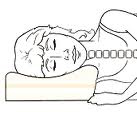
- Your pillow should be high enough to keep your neck straight (your neck should be parallel to your mattress and your head should not be tilted). This will help support the neck and avoid unnecessary pressure on the neck and shoulder muscles.
- If your neck and head deviates downwards, then your pillow is too low/small.
- If your neck and head deviates upwards, then your pillow is too high/tall.
- Also, lie with your knees bent and place a smaller pillow between them. This will help eliminate unnecessary stress on your pelvis and lower back.
On your back:
- Lie on your back with a pillow under your head.
- If your pillow does not have a neck roll/support, place a rolled-up towel under the curve of your neck. This will help hold your neck in it's correct alignment and reduce strain on your neck muscles.
- Also, place a pillow under your knees to help reduce stress and strain on your lower back.
Correct Sitting Posture at Computer
 1. Let your wrists rest on the desk with your computer directly in front of you.
2. Elbows should hang down (straight).
3. Have your chair (and desk) at the correct height so your eyes are level with the top of the computer screen. Have your buttocks near the rear of the chair and utilise the built-in back-support (where applicable or purchase a Lumbar D-Roll for the chair). Make sure the back-support is at the correct height for your lumbar curve.
4. Your knees should be slightly lower than your hip joints.
5. And your feet should be placed firmly on the ground in front of you (a foot rest may be required if your feet don't reach the floor).
This advice should help prevent forward slouching, rolled shoulders and a forward head/neck positioning. Regular breaks should be taken and appropriate exercises & stretches should also be performed to help reduce physical stress and maintain a good healthy posture.
Core-Strengthening Exercises
Pelvic Tilt / Abdominal Tightening

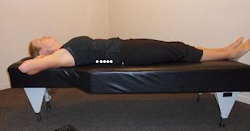
1. Lie on your back and tighten your lower abdominal and buttock muscles so you flatten your lower back curve.
2. Hold this position for 4 seconds.
3. Then relax for 4 seconds.
4. Repeat 6 times.
Pelvic Tilt
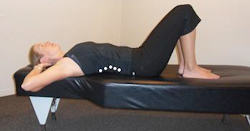
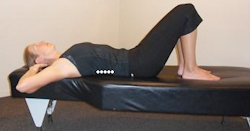
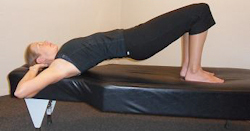
1. Lie on your back with your knees flexed and your feet flat on the floor as close to the buttocks as possible.
2. Tighten your lower abdominal and buttock muscles (so as to flatten your low back against the floor).
3. Slowly raise your hips up off the floor, and hold for 4 seconds.
4. Repeat 6 times.
Knee-to-Chest Stretch
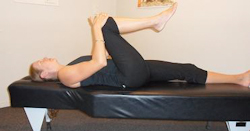
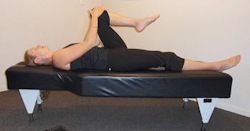
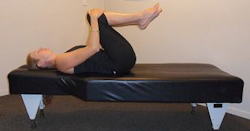
1. Lie on your back.
2. Bring your right knee up to your chest.
3. Hold this position for 4 seconds.
4. Repeat this exercise 6 times, relaxing for a few seconds between each knee-chest stretch.
5. Repeat the same exercise with left knee and hold for 4 seconds.
6. Repeat with both knees.
7. Repeat this exercise 6 times.
Abdominal Strengthening Exercise
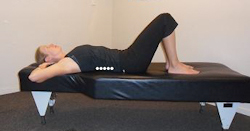
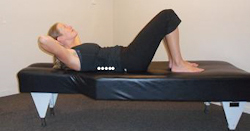
1. Lie on your back.
2. Bend your knees with your feet flat on the floor.
3. Either cross your arms over your chest or place hands behind the head to support the head and neck. (Do not pull on your neck).
4. Flatten your spine against the floor by pulling up and in with your lower abdominal muscles.
5. Lift your upper body off the floor by contracting your upper abdominal muscles.
6. Raise your upper body slowly upwards until you feel the abdominal muscles tighten.
7. Relax the abdominal muscles.
8. Allow the shoulders to return to the floor.
9. Repeat this exercise for 30-50 repetitions.
Lower Back Stretch
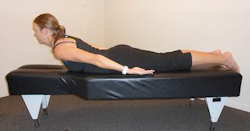
1. Lie flat on stomach with your arms along side your body (with your palms up).
2. Slowly raise your chest from the floor.
3. Feel the muscles of the lower back tighten.
4. Hold the chest up off the floor for 4 seconds.
5. Slowly let the chest down again.
6. Rest a few seconds between each session.
7. Repeat this 6 times.
Disclaimer
The purpose of this website is to provide relevant information to educate and inform the community about the advantages of Chiropractic Care and how it may improve the health and well-being of themselves and their family. The information given should only be used as a guideline. Chiropractic for Life and its colleagues will not take responsibility for any consequences or damages arising from the misuse or application of any products, services or information on this website. For professional advice on one's health and well-being, a qualified Chiropractor should be consulted.